When it comes to managing body weight, traditional methods like Body Mass Index (BMI) often fail to provide an accurate picture, especially for those with higher muscle mass or excess fat.
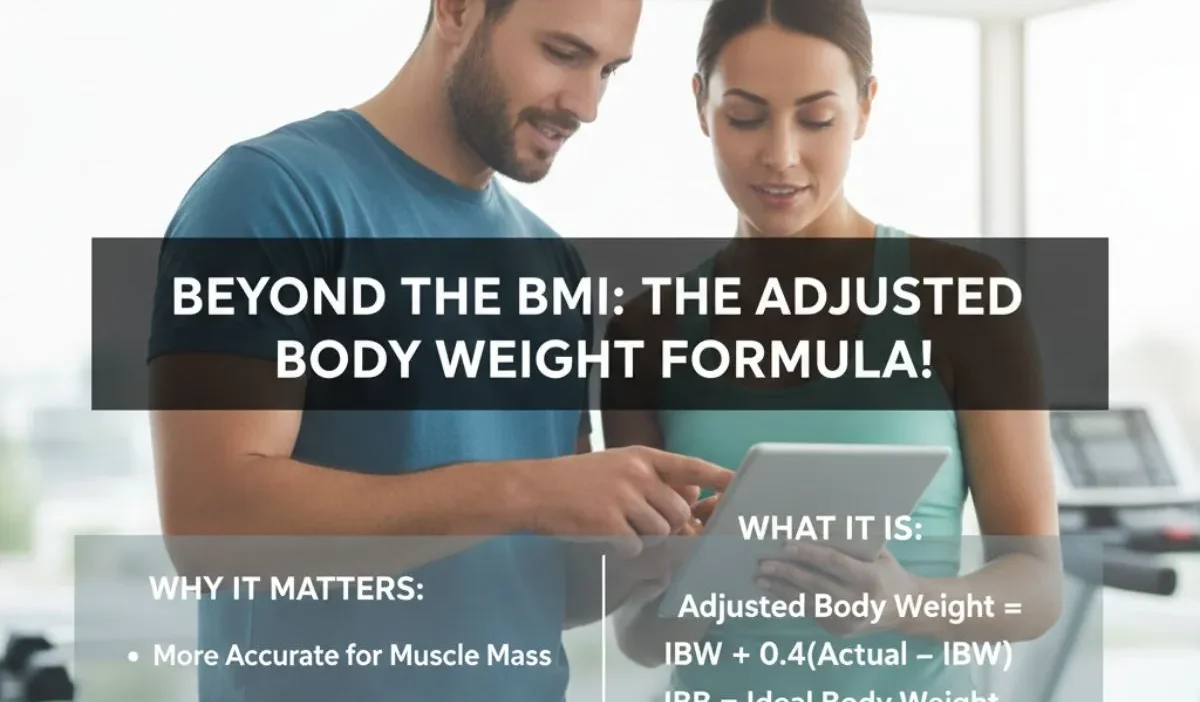
This is where the Adjusted Body Weight (ABW) formula comes in a more precise method for assessing weight, particularly for overweight or obese individuals. Unlike BMI, which treats all weight as equal, ABW takes into account both ideal body weight (IBW) and excess fat, offering a tailored approach to health assessments.
By using this formula, healthcare providers and fitness professionals can better estimate nutritional needs, calorie intake, and weight loss goals. Whether you’re trying to shed a few pounds or need an accurate measurement for a clinical diet plan, understanding how to calculate and apply ABW can help you achieve more realistic and personalized health goals.
In this article, we’ll explore the ABW formula, how to calculate it, and why it’s crucial for effective weight management.
What is the Adjusted Body Weight Formula?
The Adjusted Body Weight (ABW) formula is a more accurate way to estimate body weight for individuals who have a higher-than-ideal body fat percentage, particularly those who are overweight or obese. Traditional body weight assessments like Body Mass Index (BMI) can mislead people by not differentiating between muscle mass and fat. For example, athletes or individuals with a muscular build might fall into the “overweight” or “obese” categories, despite having a healthy body composition.
The ABW formula works by calculating the difference between a person’s Ideal Body Weight (IBW)—which is based on height and body type—and their actual body weight. The difference is then multiplied by 0.25 and added to the IBW. This helps adjust the weight estimate by factoring in excess fat while still recognizing the muscle mass. This makes the ABW formula particularly useful in clinical settings where precise caloric and nutritional requirements need to be calculated.
By incorporating ABW into weight management programs, doctors and dietitians can more effectively guide individuals toward healthier body compositions. It allows for a more personalized approach to dieting, exercise, and overall health improvement. In the next sections, we’ll take a closer look at how to calculate ABW and the key benefits it offers in weight management.
Step-by-Step Guide to Calculating Adjusted Body Weight
Calculating Adjusted Body Weight (ABW) is relatively simple once you understand the key components. To perform the calculation, you’ll need to know your Ideal Body Weight (IBW) and your Actual Body Weight (ABW). Here’s a step-by-step guide:
- Determine Your Ideal Body Weight (IBW):
- Ideal Body Weight is typically calculated based on height, gender, and body type. Several formulas can be used to calculate IBW, but the most common one is the Devine Formula, which estimates IBW as follows:
- For men:
IBW=50+2.3×(Height in inches−60)\text{IBW} = 50 + 2.3 \times (\text{Height in inches} – 60)IBW=50+2.3×(Height in inches−60) - For women:
IBW=45.5+2.3×(Height in inches−60)\text{IBW} = 45.5 + 2.3 \times (\text{Height in inches} – 60)IBW=45.5+2.3×(Height in inches−60)
- For men:
- Ideal Body Weight is typically calculated based on height, gender, and body type. Several formulas can be used to calculate IBW, but the most common one is the Devine Formula, which estimates IBW as follows:
- Calculate the Difference Between Your Actual Weight and IBW:
- Subtract your Ideal Body Weight from your Actual Body Weight.
- Subtract your Ideal Body Weight from your Actual Body Weight.
- Multiply the Difference by 0.25:
- This constant adjusts for the excess fat in the body while preserving the muscle mass.
- This constant adjusts for the excess fat in the body while preserving the muscle mass.
- Add the Result to Your IBW:
- The sum will give you your Adjusted Body Weight (ABW).
- The sum will give you your Adjusted Body Weight (ABW).
Example Calculation of Adjusted Body Weight
Let’s walk through an example to see how the Adjusted Body Weight (ABW) formula works in practice. For this, we’ll use a hypothetical person:
- Height: 5’10” (70 inches)
- Actual Weight: 230 lbs
- Gender: Male
Step 1: Calculate Ideal Body Weight (IBW)
Using the Devine formula for men:
IBW=50+2.3×(Height in inches−60)\text{IBW} = 50 + 2.3 \times (\text{Height in inches} – 60)IBW=50+2.3×(Height in inches−60) IBW=50+2.3×(70−60)=50+2.3×10=50+23=73 lbs\text{IBW} = 50 + 2.3 \times (70 – 60) = 50 + 2.3 \times 10 = 50 + 23 = 73 \text{ lbs}IBW=50+2.3×(70−60)=50+2.3×10=50+23=73 lbs
Step 2: Calculate the Difference Between Actual Weight and IBW
Difference=230 lbs−73 lbs=157 lbs\text{Difference} = 230 \, \text{lbs} – 73 \, \text{lbs} = 157 \, \text{lbs}Difference=230lbs−73lbs=157lbs
Step 3: Multiply the Difference by 0.25
157 lbs×0.25=39.25 lbs157 \, \text{lbs} \times 0.25 = 39.25 \, \text{lbs}157lbs×0.25=39.25lbs
Step 4: Add the Result to IBW
ABW=73 lbs+39.25 lbs=112.25 lbs\text{ABW} = 73 \, \text{lbs} + 39.25 \, \text{lbs} = 112.25 \, \text{lbs}ABW=73lbs+39.25lbs=112.25lbs
Thus, the Adjusted Body Weight (ABW) for this individual is 112.25 lbs. This more accurately reflects the person’s lean mass and excess fat compared to their actual weight, helping to guide more personalized health and fitness decisions.
Why Use Adjusted Body Weight?
The Adjusted Body Weight (ABW) formula is particularly useful because it provides a more accurate representation of a person’s body composition, especially for individuals who fall outside the standard weight classifications. Traditional weight metrics, like Body Mass Index (BMI), don’t account for the difference between fat and muscle, which is crucial for an accurate health assessment.
For instance, athletes or bodybuilders with high muscle mass may be categorized as overweight or obese according to BMI, even though they have low body fat. On the other hand, those with excess body fat may be deemed “healthy” based solely on BMI, even though they might be at risk for diseases like diabetes, hypertension, and cardiovascular issues. ABW addresses these limitations by factoring in both ideal body weight (IBW) and excess weight—providing a more realistic estimate of the individual’s fat mass and lean tissue.
In clinical settings, ABW helps healthcare providers prescribe more accurate caloric intake and nutritional needs for overweight or obese patients. It’s particularly beneficial when determining how much weight an individual should lose or maintain to achieve better health outcomes. ABW is also invaluable in fitness programs, as it offers a more tailored approach to setting achievable weight loss and muscle-building goals.
ABW in Practical Applications
The Adjusted Body Weight (ABW) formula has significant applications in both medical and fitness contexts. In healthcare, it plays a crucial role in determining a patient’s nutritional needs and creating personalized treatment plans. For individuals who are overweight or obese, ABW provides a more accurate estimate of fat mass, allowing doctors and dietitians to calculate caloric intake and macronutrient distribution with greater precision.
For example, a person with excess body fat may need fewer calories than their actual weight suggests, as their excess fat doesn’t require as much energy to maintain. ABW helps clinicians avoid overestimating caloric needs, which could lead to unnecessary weight gain or hinder weight loss progress. Similarly, ABW assists in tailoring weight loss programs, as it provides a more accurate assessment of how much weight needs to be lost to reach a healthier body composition.
In the fitness world, ABW is invaluable for setting realistic goals. For athletes or individuals with a high muscle-to-fat ratio, the formula ensures that weight loss goals are focused on fat reduction rather than muscle loss. It also helps track progress in a way that doesn’t penalize individuals for naturally heavier builds due to muscle mass, offering a more holistic approach to fitness and well-being.
Common Misconceptions and Limitations of Adjusted Body Weight
While the Adjusted Body Weight (ABW) formula is a useful tool for assessing body composition, it’s important to understand its limitations and avoid common misconceptions. One of the biggest misunderstandings is that ABW can completely replace Body Mass Index (BMI) or other health assessments. In reality, ABW is just one part of the picture and should be used alongside other tools for a comprehensive evaluation of an individual’s health.
For instance, ABW is designed to work well for individuals who are moderately overweight or obese, but it may not be accurate for people with severe obesity. When body fat exceeds a certain threshold, the ABW formula might not adequately reflect the actual proportion of lean body mass to fat, leading to skewed results.
Additionally, ABW doesn’t account for factors like age, genetics, or fat distribution, all of which can influence a person’s health and body composition. For example, older adults tend to lose muscle mass, making the formula less reliable for assessing body composition in this population. Similarly, the formula assumes that excess weight is primarily fat, but some individuals may carry more visceral fat or have medical conditions that alter fat distribution, impacting the accuracy of ABW for them.
Thus, while ABW provides a more personalized approach than BMI, it should be used with caution and in combination with other measurements.
How to Incorporate ABW into Your Weight Management Strategy
Incorporating Adjusted Body Weight (ABW) into your weight management strategy allows for a more personalized and realistic approach to achieving your health and fitness goals. One of the key benefits of using ABW is that it helps distinguish between lean body mass and fat, making it easier to develop a sustainable weight loss or maintenance plan based on fat reduction rather than just focusing on overall weight loss.
When using ABW, start by calculating your Ideal Body Weight (IBW) and then assess your Adjusted Body Weight (ABW). From there, you can set more accurate goals, such as how much fat you want to lose to reach a healthier body composition. This gives you a clearer target and prevents unnecessary focus on losing muscle mass, which is often the case when using BMI or other general weight loss metrics.
ABW can also help tailor your dietary plan. For example, if you are overweight but carry a significant amount of muscle mass, ABW can prevent you from being advised to drastically reduce calories, which could lead to muscle loss. By understanding your ABW, you can adjust macronutrient intake to preserve muscle while reducing fat, improving overall metabolic health.
Moreover, incorporating ABW into fitness routines ensures that you’re targeting fat loss through strength training and cardio, instead of inadvertently losing lean muscle, which is key to long-term health and fitness success.
FAQs About Adjusted Body Weight (ABW)
1. What is the difference between ABW and BMI?
ABW takes into account the difference between a person’s Ideal Body Weight (IBW) and actual weight, adjusting for excess fat. Unlike Body Mass Index (BMI), which doesn’t differentiate between fat and muscle, ABW offers a more accurate picture of an individual’s body composition, particularly for those with high muscle mass or excess fat.
2. Can ABW be used for children?
ABW is generally designed for adults, especially those with obesity or overweight. For children, growth charts and pediatric-specific formulas are used to assess healthy weight ranges, as children’s bodies go through different stages of growth and development.
3. How often should I calculate my ABW?
ABW should be recalculated periodically, especially when significant changes occur in your weight or body composition. This could be after completing a weight loss or fitness program, or when making dietary or exercise adjustments.
4. Does ABW work for people with extreme obesity?
While ABW can be helpful for individuals who are overweight or moderately obese, its accuracy decreases for people with severe obesity due to the complexity of fat distribution at higher body fat percentages. In such cases, additional measurements like body fat percentage might be necessary.
5. Is ABW the best tool for everyone?
No, ABW is just one of several methods to assess health. It’s most effective when used alongside other health metrics such as body fat percentage, waist-to-hip ratio, and lean mass assessments for a well-rounded understanding of body composition.
Conclusion
The Adjusted Body Weight (ABW) formula offers a more accurate and personalized approach to assessing body weight, especially for individuals with excess fat or higher muscle mass. Unlike traditional methods like BMI, which can be misleading for people with unique body compositions, ABW helps to better estimate fat mass and lean tissue. By incorporating ABW into weight management strategies, healthcare providers and fitness professionals can create more tailored diet and exercise plans, improving overall health outcomes.
While ABW is an invaluable tool, it’s important to remember that no single formula can provide a complete picture of an individual’s health. Factors like age, genetics, and fat distribution should also be considered when assessing body composition. ABW is best used alongside other measurements, such as body fat percentage and waist-to-hip ratio, for a comprehensive health assessment.
Whether you’re working to lose weight, build muscle, or maintain a healthy body, ABW can guide you toward more realistic goals and a healthier, more sustainable approach to fitness. By understanding how to calculate and apply ABW, you empower yourself to make informed decisions about your health and weight management journey. As always, consult with a healthcare professional or dietitian when making significant changes to your weight management plan.

I’m John, the voice behind PeacefulQuotes.com. I craft quotes that spark reflection, inspire calm, and bring a moment of peace to your day.