UFC weight classes are the foundation of fair and exciting competition in mixed martial arts. Without them, fights would be decided more by size than skill, putting fighters at risk and reducing the quality of matchups.
Weight classes group athletes by similar body mass, allowing speed, technique, power, and strategy to shine on an even playing field. Whether you are a new fan trying to understand the structure of the sport or a longtime viewer looking to deepen your knowledge, knowing how UFC divisions work completely changes how you watch a fight.
From the lightning-fast flyweights to the knockout-heavy heavyweights, each division has its own identity, pace, and type of athlete. This guide will break down every UFC weight class, explain the rules behind them, explore weight cutting, and show how fighters choose their divisions. By the end, you will understand why weight classes matter and how they shape champions.
What Are UFC Weight Classes?
UFC weight classes are divisions that separate fighters based on their body weight to ensure fair and competitive matchups. Instead of allowing athletes of all sizes to fight each other, the UFC groups fighters into specific categories, each with a maximum weight limit. This system prevents extreme size differences and allows skill, speed, power, and technique to be the deciding factors in a fight rather than sheer physical advantage.
In simple terms, weight classes create balance. A 125-pound fighter competing against a 265-pound heavyweight would be dangerous and unfair. By organizing fighters into divisions such as Flyweight, Lightweight, or Heavyweight, the UFC protects athletes and maintains the integrity of the sport. These classes also help fans understand how fighters compare to one another and how championships are structured.
Each weight class has its own championship belt, meaning there are multiple champions across different divisions. This adds depth and excitement to the UFC, as fighters can aim to dominate their category or even attempt to become a champion in more than one division. Fighters usually compete at a weight lower than their natural body weight, using weight-cutting methods to reach the official limit before weigh-ins.
UFC weight classes are regulated by athletic commissions and follow strict rules. Fighters must hit the required weight during official weigh-ins to be eligible to compete. Missing weight can lead to fines, loss of title opportunities, or even fight cancellations. Overall, weight classes are essential for safety, fairness, and the competitive structure that makes the UFC one of the most respected combat sports organizations in the world.
History of Weight Classes in the UFC
When the UFC was first created in 1993, there were no weight classes at all. Fighters of any size could compete against each other, leading to extreme mismatches. It was common to see much smaller athletes facing opponents who outweighed them by 50 to 100 pounds. While this format was designed to showcase different martial arts styles, it raised serious concerns about fighter safety and fairness. Size often became a bigger factor than skill, which limited the sport’s long-term credibility.
As mixed martial arts grew in popularity, athletic commissions and regulators pushed for standardized rules. In the late 1990s and early 2000s, the UFC began adopting weight classes similar to those used in boxing and wrestling. This change marked a major turning point for the organization. It helped legitimize MMA as a professional sport and made competition more balanced and strategic.
The introduction of the Unified Rules of Mixed Martial Arts played a crucial role in shaping the modern UFC weight class system. These rules established official weight divisions, safety regulations, and consistent judging criteria. Over time, the UFC expanded and refined its divisions to better accommodate fighters of different sizes and body types.
Women’s weight classes were added later as women’s MMA gained recognition, further expanding the structure of the sport. Today, UFC weight classes are an essential part of its identity. They ensure safer competition, create clearer championship paths, and allow fans to compare fighters more accurately. The evolution from no limits to a structured system helped transform the UFC into a global, professional combat sports organization.
Complete List of Men’s UFC Weight Classes
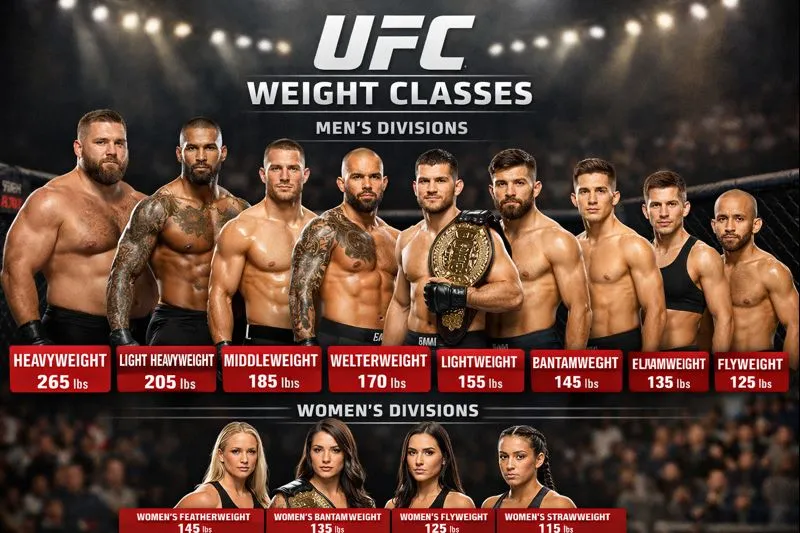
The UFC features eight official men’s weight classes, each designed to group fighters with similar body size and physical strength. These divisions create balanced matchups and allow different fighting styles to shine. From fast and technical lighter divisions to powerful knockout-heavy heavier ones, each weight class brings its own excitement and identity to the sport.
The Flyweight division tops out at 125 pounds and is known for speed, cardio, and technical precision. Fighters here rely on movement, quick combinations, and endurance. Next is Bantamweight at 135 pounds, where speed remains important but power begins to play a larger role. Featherweight at 145 pounds is often seen as one of the most exciting divisions because it balances speed, skill, and knockout potential.
Lightweight at 155 pounds is considered the deepest and most competitive division in the UFC. It has produced many legendary fighters and classic rivalries. Welterweight at 170 pounds features athletes with a strong mix of size, power, and athleticism. Middleweight at 185 pounds is known for explosive striking and highlight-reel knockouts.
Light Heavyweight at 205 pounds combines strength with surprising speed and technique. Many dominant champions have come from this class. Finally, Heavyweight tops out at 265 pounds and showcases the biggest and strongest fighters in the UFC. A single punch can change everything in this division, making it one of the most unpredictable.
Together, these eight divisions form the backbone of men’s competition in the UFC, giving fighters clear paths to championships and fans a structured way to understand the sport.
Complete List of Women’s UFC Weight Classes
The UFC currently has four official women’s weight classes, each offering a unique style of competition and showcasing the growing depth of female talent in mixed martial arts. These divisions have helped legitimize and elevate women’s MMA, producing some of the most skilled and dominant champions in UFC history.
The Strawweight division has a limit of 115 pounds and is known for its high pace, technical striking, and nonstop movement. Fighters in this class rely heavily on speed, endurance, and precision rather than raw power. It is often considered one of the most competitive women’s divisions because of its deep talent pool and constant title changes.
The Flyweight division at 125 pounds offers a balance between speed and strength. Fighters here combine strong grappling skills with sharp striking. This division has become a showcase for well-rounded athletes who can excel both on the feet and on the ground.
The Bantamweight division, capped at 135 pounds, is where women’s MMA first gained major recognition in the UFC. It features powerful athletes with strong striking ability and physical dominance. Many of the sport’s biggest stars have competed in this class, making it one of the most historically significant women’s divisions.
The Featherweight division at 145 pounds is the least active women’s division and has fewer fighters. However, it has still produced memorable champions and remains an important part of UFC history. Together, these four weight classes give female fighters clear championship paths and provide fans with diverse and exciting matchups.
Why Weight Classes Are Important in the UFC
Weight classes are essential to the safety, fairness, and credibility of the UFC. Without them, fights would often be decided by size alone rather than skill, technique, and strategy. A significant weight difference can give one fighter an overwhelming advantage in strength, reach, and durability, making competition dangerous and unbalanced. By separating athletes into divisions based on weight, the UFC creates an environment where ability and preparation matter more than physical size.
One of the most important reasons weight classes exist is fighter safety. Combat sports already involve high risk, and allowing large mismatches would increase the chances of serious injury. Weight divisions reduce these risks by ensuring fighters face opponents of similar size and power. This makes fights more competitive while protecting the long-term health of athletes.
Weight classes also create fairness in competition. They give every fighter an equal opportunity to succeed, regardless of body type. Smaller fighters are not forced to compete against much larger opponents, and larger fighters do not dominate purely because of physical advantages. This balance allows different fighting styles to thrive, from fast and technical strikers to powerful wrestlers and knockout artists.
Additionally, weight classes structure the championship system. Each division has its own title, rankings, and contenders, which adds depth to the UFC. It creates more opportunities for fighters to become champions and gives fans multiple storylines to follow. Overall, weight classes are the backbone of professional MMA and are crucial to making the UFC a respected and competitive sport.
How Fighters Choose Their Weight Class
Choosing the right weight class is one of the most important decisions in a UFC fighter’s career. It affects performance, health, longevity, and overall success inside the Octagon. Fighters usually start by considering their natural walking weight, which is the weight they maintain when they are not in training camp. From there, they determine how much weight they can safely cut before a fight without hurting their strength or endurance.
Body composition plays a major role in this decision. Fighters with lower body fat percentages may struggle to cut large amounts of weight, while those with higher fat levels may find it easier to drop pounds. Height and reach also matter, as some fighters prefer divisions where they have a size or length advantage over their opponents.
Another factor is fighting style. Speed-based fighters often choose lighter divisions where movement and cardio are key, while power-focused fighters may prefer heavier classes where strength and knockout ability are more valuable. Wrestlers and grapplers sometimes select divisions where their physical strength gives them a control advantage.
Career strategy is also important. Some fighters move down to gain a size advantage, while others move up to avoid difficult weight cuts and improve their health. However, cutting too much weight can lead to fatigue, weaker chins, and poor performance. On the other hand, moving up a division means facing stronger and often larger opponents.
Ultimately, fighters aim to find the division where they feel strongest, healthiest, and most competitive. The right weight class can be the difference between an average career and a championship run.
Weight Cutting Explained
Weight cutting is the process fighters use to temporarily reduce their body weight before the official weigh-in so they can compete in a lower weight class. Most UFC fighters do not fight at their natural body weight. Instead, they cut several pounds in the final days before a fight and then rehydrate afterward to regain strength and size inside the Octagon.
The process usually begins with fat loss during training camp. As the fight approaches, fighters use methods such as reducing water intake, limiting sodium, sweating in saunas, hot baths, or wearing sweat suits to lose water weight. This can cause rapid drops in body weight, sometimes 10 to 20 pounds or more depending on the division and the athlete. After the weigh-in, fighters immediately begin rehydrating by drinking fluids and eating carbohydrates to restore energy and muscle fullness.
Weight cutting gives fighters a size advantage on fight night, allowing them to enter the cage heavier than the official limit of their division. This can improve strength, grappling control, and overall physical presence. However, it also comes with serious risks. Extreme dehydration can lead to fatigue, slower reaction times, reduced endurance, and increased vulnerability to head trauma.
There are growing concerns about the long-term health effects of weight cutting. Some athletic commissions and organizations have discussed implementing stricter rules to limit dangerous cuts. Many fighters are now choosing to compete closer to their natural weight for better performance and safety. While weight cutting remains a major part of MMA culture, understanding its dangers is crucial for appreciating how challenging and demanding the sport truly is.
Missed Weight and Its Consequences
Missing weight is one of the most serious issues a UFC fighter can face during fight week. It happens when a fighter fails to meet the official weight limit for their division at the weigh-in. This usually means their weight cut was poorly planned, too extreme, or affected by health problems. Missing weight not only impacts the fighter but can also disrupt the entire event.
The most common consequence is a financial penalty. Fighters who miss weight are typically fined a percentage of their fight purse, often between 20% and 30%, which is given to their opponent. This can be a major loss, especially for lower-ranked fighters who rely heavily on their fight earnings.
In some cases, the fight can still go on if the opponent agrees, but it becomes a catchweight bout. However, if a fighter misses weight badly or shows signs of severe dehydration, the fight may be canceled for safety reasons. This is disappointing for fans and costly for both fighters.
For title fights, the consequences are even stricter. If a champion misses weight, they are stripped of the ability to defend their title. Even if they win the fight, they cannot retain the belt. If a challenger misses weight, they become ineligible to win the championship.
Missing weight can also damage a fighter’s reputation. It suggests poor discipline and preparation. Repeated failures can hurt career opportunities and trust from promoters. In the UFC, professionalism is highly valued, and making weight is seen as a basic responsibility of every fighter.
Moving Between Weight Classes
Moving between weight classes is a common strategy in the UFC and can completely change a fighter’s career. Fighters may choose to move up or down a division based on performance, health, or competitive advantage. Sometimes a fighter struggles with extreme weight cuts and decides to move up to a higher division to feel stronger, faster, and more durable. In other cases, a fighter moves down to gain a size or strength advantage over smaller opponents.
Moving up a weight class often improves a fighter’s energy levels and durability. They no longer need to drain their body through heavy dehydration, which can result in better cardio, stronger punches, and improved recovery. However, the downside is facing larger and naturally stronger opponents. Power, physical strength, and reach differences become more noticeable, and a fighter must adapt their style to survive.
Dropping to a lower weight class can offer physical advantages such as increased size, strength, and grappling control over opponents. This can be beneficial for wrestlers and pressure fighters. But severe weight cuts can weaken stamina, slow reactions, and increase the risk of being knocked out. If not done carefully, moving down can shorten a fighter’s career.
Some fighters have successfully become champions in multiple divisions, proving that weight class changes can lead to greatness. Others have struggled, showing how difficult the transition can be. Every weight class has its own speed, power level, and tactical demands.
Ultimately, moving between divisions is a calculated risk. When done correctly, it can unlock a fighter’s full potential. When done poorly, it can expose weaknesses and negatively affect long-term performance and health.
FAQs About UFC Weight Classes
How many weight classes are there in the UFC?
The UFC has eight men’s weight classes and four women’s weight classes. Each division has a specific weight limit to ensure fair competition and fighter safety.
Do fighters compete at their natural weight?
No, most fighters compete below their natural body weight. They cut weight before the official weigh-in and then rehydrate to fight at a heavier weight inside the Octagon.
What happens if a fighter misses weight?
If a fighter misses weight, they are usually fined a percentage of their purse, which goes to their opponent. The fight may still happen as a catchweight bout, but title implications can be affected.
Can a fighter fight in more than one weight class?
Yes, many fighters move between divisions during their careers. Some have even become champions in multiple weight classes, known as double champions.
Why is Lightweight considered the most competitive division?
Lightweight has a deep talent pool, a large number of elite fighters, and consistently high-level matchups, making it one of the toughest divisions in the UFC.
What is a catchweight fight?
A catchweight fight happens when fighters agree to compete at a weight that does not match a standard division limit, usually due to weight-cutting issues.
Are weight classes the same in all MMA organizations?
Most organizations follow similar structures, but exact limits and available divisions can vary slightly.
Is weight cutting dangerous?
Yes, extreme weight cutting can be dangerous. It can affect hydration, brain health, endurance, and long-term performance if not managed properly.
Which weight class has the most knockouts?
Heavier divisions like Middleweight, Light Heavyweight, and Heavyweight tend to have more knockouts due to higher power levels.
Conclusion
UFC weight classes are the backbone of mixed martial arts competition. They bring structure, safety, and fairness to a sport where physical differences can greatly impact performance. By dividing fighters into specific categories based on weight, the UFC ensures that skill, strategy, and preparation decide the outcome of fights rather than size alone. Each division has its own identity, pace, and type of athlete, which is what makes the sport so diverse and exciting for fans.
Understanding weight classes helps you appreciate the challenges fighters face, from choosing the right division to managing difficult weight cuts and making weight on fight week. It also allows you to better analyze matchups, recognize physical advantages, and understand why some fighters dominate certain divisions while struggling in others. Every champion’s journey is shaped by the weight class they compete in.
From the fast-paced Flyweight division to the explosive power of Heavyweight, each class plays an important role in the UFC’s competitive landscape. Women’s divisions have also added depth and history to the sport, proving that MMA excellence exists across all sizes and genders.
Whether you are a casual viewer or a hardcore fan, knowing how UFC weight classes work enhances your experience. It turns every fight into more than just a contest of strength and highlights the technical and strategic brilliance of mixed martial arts.

I’m John, the voice behind PeacefulQuotes.com. I craft quotes that spark reflection, inspire calm, and bring a moment of peace to your day.